Cervera

Contact information:


Cervera

Oficina de turisme de Cervera - Av. Francesc MaciĆ , 78
25200, Cervera
Web: http://www.turismecervera.cat
Email: turisme@cervera.cat
973534442


Share:


Comparteix a facebook
Comparteix a Twitter
Compartir a Whatsapp
Envia a un amic
Imprimir


  • Within a relatively reduced space and limited time, visitors to Cervera (La Segarra) will find a very complete historical and artistic testimony. These records not only relate to the capital of La Segarra, but also to some of the most important milestones in the history of Catalonia.
     

    The geographic location of Cervera, which occupies a hilltop site, has long conditioned the physical structure of the town, giving rise to its narrow streets, sloping neighbourhoods and covered alleys, which provoke thoughts of witches and Black Sabbats. As with the winding main street, everything adjusts to the town’s topography, while the defensive nature of the site has been made even more evident by the buttresses supported by its time-honoured walls.
     

    At one end of the oldest part of the settlement, it is possible to find the gothic-style temple of Santa Maria and to observe the rugged austerity of the Casa de la Vila (Town Hall), which is only broken by the corbels that attach the balconies to the facade of the building. Further on, we find the university, which occupies a space that was once occupied by a neighbourhood of rural workers. In the north of Cervera, we find the railway station and a number of storage buildings amongst which the Sindicat building is perhaps the most imposing; this belonged to the institution which dominated and regulated the industry of Cervera during the late 19th and early 20th centuries.


    What to visit:


    Monuments:
     

    • THE UNIVERSITY: This is the oldest and most representative building in the town, on account of its great historic importance. The main façade, which is in the baroque style, is supported on blocks of stone and framed by a monumental portal with two columns on each of its sides. Above the doorway, there is a statue of the Virgin of the Immaculate Conception, the patron saint of this institution. The royal crown on the highest part of the building serves as a reminder of its foundation by the Spanish monarchy. The chapel, or auditorium, contains a magnificent altarpiece dedicated to the Immaculate Conception, the patron saint of the institution’s students. BCIN (Monument declared a Cultural Good of National Interest).   
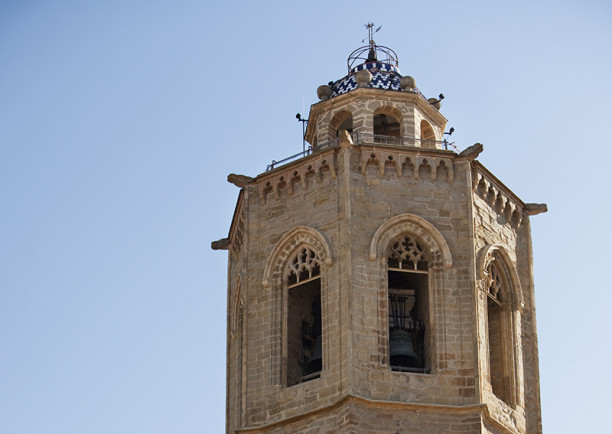
    • THE CHURCH OF SANTA MARIA: A building whose construction began in the latter years of the 13th century and which was mainly built during the 14th century and finished in the 15th century. It is particularly relevant to highlight the windows by Colí de Maraya and the sculpture of the Virgin and Child, known as the Dark Virgin of the Coll de les Savines, which stands next to the Romanesque-style monumental doorway to the sacristy. Another characteristic worthy of mention is the fact that the bell tower has been fitted into the space between the church and La Paeria (Town Hall) and that its six bells are still rung by hand. BCIN (Monument declared a Cultural Good of National Interest)
       
    • THE WALL: The walls that can be seen at Cervera mainly date from the medieval period and were built between the 14th and 15th centuries, during the reign of King Pere the Ceremonious. They were constructed on a site that had already been built on before the 13th century. In total, the wall was once over 3,000 metres long. BCIN (Monument declared a Cultural Good of National Interest)
       
    • THE MONUMENT TO THE GENERALITAT: This work by J. M. Subirachs represents the recovery of the Generalitat de Catalunya (Autonomous Government of Catalonia) and one of its four pillars, which represent the four bars of the Catalan flag, records the most important milestones in the history of Catalonia. 
       
    • THE SINDICAT: A work by Cèsar Martinell, a disciple of Gaudí. Its main function was to house flour-making machinery and to provide agricultural services. This was done in order to reduce to the minimum the cost of consumption and dependence on intermediaries and to thereby enable small-sale farmers to make greater profits. BCIN (Monument declared a Cultural Good of National Interest)
       
    • SANT PERE THE GREAT: Located on the road to Vallfogona. This is a small, Romanesque-style church with a circular floor plan and steeple. It is the only remaining part of what was once a group of monastic buildings that had been associated with the monastery of Ripoll. BCIN (Monument declared a Cultural Good of National Interest)
       
    • THE PAERIA OF CERVERA: A baroque-style building dating from the 18th century, which stands in the Plaça Major (main square). The most outstanding features of the facade of this majestic building are the corbels located under the balconies. From left to right, the different groups represent: the virtues that traders had to have, the five senses and motives related to the prison.  BCIN (Monument declared a Cultural Good of National Interest).
       
    • THE CASTLE: Built in the 9th century, this building occupies the highest point on Montseré hill. It was built under royal jurisdiction and the old town grew up around it. Nowadays, only its external walls remain. BCIN (Monument declared a Cultural Good of National Interest)
       
    • THE CASA DURAN I SANPERE HOUSE MUSEUM: Carrer Major, núm. 115. Casa Duran is one of the municipal museums of Cervera and is officially known as the Museu Duran i Sanpere. It is considered the ancestral home of the Cervera branch of the Duran family, although they also owned other buildings in the Carrer Major (main street). Aesthetically speaking, the building belongs to the bourgeois style of the restoration period


    Other places to visit:


    • THE MAIN STREET: The Carrer Major (main street) shows us how its twisting form has been adapted to that of the local terrain. Along the route, visitors will see a series of unique buildings that tell us much about the town’s splendid past. 
       
    • THE WITCHES' ALLEY: In its early days, Cervera was an enclosed settlement and the outside walls of the houses served as defensive walls protecting the old centre. The Witches' Alley was created at a later date, when the balconies of the houses that had adjoining vegetable gardens were closed off to create this very special and magical space.  
       

    • THE GALLOWS: Located in the eastern part of the town and a little removed from the main settlement, it is possible to find this curious limestone structure which had once been used as a public place for administering justice to delinquents condemned to death by hanging. 
       

    • SANTA ANNA SQUARE: Before going into the Carrer Major, visitors will come to the Plaça Santa Anna square. At this point, at the end of the Carrer Major, access to the town is closed by the Portal de Santa Maria gate.
       

    • THE MAIN SQUARE: This has a uniform, symmetrical appearance thanks to the modifications made by King Carlos IV as part of the festivities to commemorate his accession to the throne in 1789. It is also important to highlight the part of the square with porches, which was constructed from 1401 onwards, which once ran the whole length of the Carrer Major. Today, there are only two porched sections of the Plaça Major, with another two at the end of the main street.


    Routes:


    MTB and trekking routes through La Segarra:  La Segarra offers a rugged yet often charming landscape which exhibits major contrasts from one season to another, when the comarca (local district) takes on a different appearance. This allows visitors to enjoy a series of different MTB and walking routes as they discover the comarca and its many secret corners. The routes take in various places of cultural and historical interest which visitors will discover as the route unfolds.


    Markets:


    • Weekly market: Every Friday morning.  Street market where it is possible to buy fresh products straight from the market gardens of local farmers.
    • Antiques and traditional craft market: On the first Saturday of each month from 5 pm onwards. There are around twenty stalls and toasted snacks are handed out to everyone who attends. 
    • Christmas Fair Market: Held in the month of December in the Carrer Major and the Plaça Major, with various activities (communal Nativity scene, choir performance, a variety of toasted snacks, concert, show for children ...)